AC Repair in Columbus, GA
When the AC Stops Working in a Columbus Summer
On a July afternoon in Columbus, a broken air conditioner stops being an inconvenience fast. Temperatures along Macon Road and Victory Drive routinely hit 93 degrees, and with the humidity that settles over the Chattahoochee River corridor, the heat index pushes past 100 degrees before noon. A failed capacitor, a refrigerant leak, or a locked-up compressor means your home can go from comfortable to dangerous in just a few hours.
Elite Service Comp
any LLC has been handling AC repair in Columbus, Georgia and the surrounding region for over a decade. Joseph Perez, the owner and lead technician, graduated from Columbus Technical College with an Air Conditioning Technology diploma and has 16 years of hands-on experience diagnosing and repairing residential and commercial HVAC systems. When your air conditioner fails in the middle of a Georgia heat wave, you want a technician who knows Columbus neighborhoods, Columbus homes, and the specific demands that come with this climate.
Elite Service Company holds Georgia contractor license CR-110338, carries full liability coverage and bonding, and is EPA Section 608 certified for refrigerant handling. The company is an active ACCA member and an authorized Goodman dealer. With a 5.0 rating across 580 Google reviews and 24/7 emergency service availability, Elite has become the go-to call for Columbus homeowners when the AC stops working.
Call Now for Same-Day Service
Common AC Problems Columbus, GA Homeowners Face
Electrical Component Failures
Columbus AC systems face a specific challenge: they run longer and harder than systems in most other parts of the country. The combination of summer heat and near-constant humidity means a residential air conditioner in Wynnton or Bradley Park can log 1,800 to 2,200 hours of runtime per year. That kind of continuous demand accelerates component wear across the board.
Electrical component failures are the most common call Elite Service Company receives. Capacitors start and run the compressor and blower motors. When a capacitor weakens or fails, the compressor tries to start, struggles, and either cycles off or locks out entirely. Contactors, the switch that tells the compressor to run, wear down from the constant switching cycles of a long Columbus cooling season. Both components are high-failure items in systems over seven to ten years old.
Refrigerant Issues and Coil Problems
Refrigerant problems tend to develop more slowly. A system with a small leak in the evaporator coil or refrigerant line set will lose charge gradually over one or two seasons. As refrigerant drops below the manufacturer-specified level, the system loses cooling capacity and the evaporator coil can freeze solid, blocking airflow entirely. Columbus homes that still operate on R-22 refrigerant face an additional challenge: R-22 has been phased out of production, which means repair costs for older systems are substantially higher than they used to be.
Compressor and Blower Failures
Compressor failures represent the most serious category of AC repair. When the compressor, the heart of the system, fails, homeowners are looking at a major repair or full replacement depending on system age and remaining warranty coverage.
Warning Signs Your AC Needs Repair in Columbus, GA
Warm Air or Reduced Airflow That Spreads Through the Duct System
Warm air or reduced airflow is frequently the first indicator. If your home takes noticeably longer to reach the thermostat setpoint, or rooms at the end of long duct runs in older homes along Forrest Road and Manchester Expressway feel stuffy while others stay cool, the system is losing capacity. This symptom can trace to low refrigerant, a failing compressor, or a clogged filter and dirty coil.
Ice Forming on the Evaporator Coil That Blocks the Air Handler
Ice on the evaporator coil is a visible mechanical problem. When refrigerant pressure drops or airflow through the coil is restricted, the coil surface temperature falls below freezing and moisture from the air builds up as ice. A frozen coil blocks airflow entirely, which shuts down cooling and can cause condensate to overflow into the air handler and ceiling. Homeowners sometimes notice water dripping from supply registers or dark staining around ceiling vents before realizing the coil is frozen.
Unusual Sounds That Indicate Bearing and Motor Damage
Grinding, rattling, or squealing sounds during startup or operation indicate bearing wear in the blower motor or fan motor. Left running, worn bearings eventually seize, which burns out the motor. A hissing or bubbling sound near the outdoor unit often points to a refrigerant leak at a fitting or through a pinhole in the coil.
High Electricity Bills That Signal a System Running Past Capacity
Energy bills that spike without a corresponding change in usage habits tell a clear story: the system is working significantly harder than it should be to maintain the same temperature setpoint. A poorly performing evaporator coil, a weak capacitor causing motor inefficiency, or a refrigerant charge that is off by ten percent can translate into a fifteen to twenty-five percent increase in monthly cooling costs before the system shows any other obvious symptom.


Our AC Repair Process in Columbus, GA
Step 1. System Diagnosis at the Unit and Thermostat
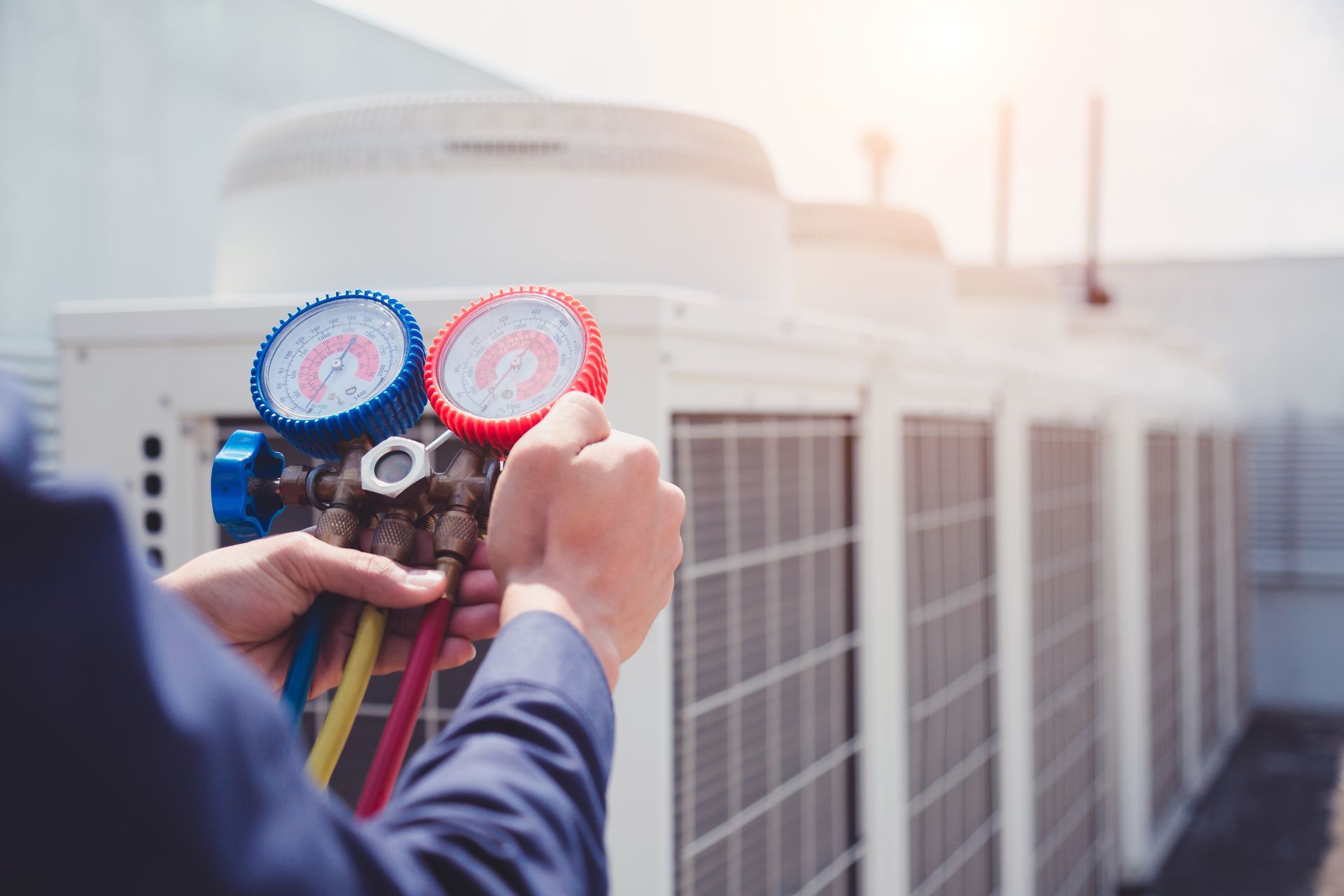
The diagnostic phase covers the full system. Technicians check refrigerant charge using manifold gauges, test capacitor microfarad values against nameplate ratings, inspect contactor surface condition, measure motor amperage draw, verify thermostat calibration and staging, and inspect the evaporator coil and condensate drain system. A system showing warm air or long run cycles often has more than one contributing issue, and finding all of them in a single visit prevents callbacks.
Step 2. Written Scope and Transparent Pricing
The written scope confirms exactly what is being repaired, what parts are being installed, and what the total price is before any work begins. Columbus homeowners do not pay a surprise invoice at the end of a service call. Elite Service Company does not proceed with any repair without the homeowner's written authorization on a priced estimate.
Step 3. Permit Coordination with the CCG Inspections and Code Department
For certain AC replacement or major repair work, a mechanical permit is required through the Columbus Consolidated Government Inspections and Code Department, located at 420 10th Street, Columbus, GA 31901, reachable at (706) 653-4126. Elite Service Company pulls, manages, and coordinates all required permits so homeowners do not have to interact with the permit process directly. Permitted work is also the only work that carries full warranty protections from both the equipment manufacturer and the contractor.
Step 4. Repair Execution with Manufacturer-Certified Parts
Repair execution uses OEM or manufacturer-approved replacement parts. Capacitors, contactors, refrigerant, coils, and fan motors installed by Elite match the original equipment specifications. Refrigerant recovery and recharge is performed by EPA Section 608 certified technicians in full compliance with all federal handling requirements.
Step 5. Performance Verification Before We Leave
Before leaving, every repair call closes with a performance verification. Technicians confirm supply air temperature, system pressures, delta-T across the evaporator coil, and thermostat staging. The system runs through a complete cycle before the job is marked complete.
Understanding Your AC Repair Options in Columbus, GA
Scenario 1. Minor Repairs on Systems Under Ten Years Old
Systems under ten years old with a single failed component like a capacitor, contactor, thermostat, or low refrigerant from an identifiable and repairable leak are strong repair candidates. These repairs carry real value. A capacitor replacement or refrigerant charge with leak repair on a system that tests within spec everywhere else will restore full performance and extend useful system life by several more seasons. On systems with active manufacturer warranties, Elite verifies warranty coverage and ensures parts sourcing and installation practices comply with warranty requirements.
Scenario 2. Major Component Repair on Mid-Life Systems
Mid-life systems in the ten to fifteen year range that have experienced a major component failure require a more careful analysis. A compressor replacement, evaporator coil replacement, or condenser coil replacement on a system approaching fifteen years is a case where the repair cost relative to system value deserves an honest conversation. Elite's technicians run the calculation and present both options. Some homeowners choose the repair to buy another three to five years before a planned replacement. Others use the failure as the trigger to move forward with a new high-efficiency system. Neither choice is pressured on a service call.
Scenario 3. Full System Evaluation for Older Equipment
Systems over fifteen years old, systems still operating on the phased-out R-22 refrigerant, or systems showing multiple simultaneous failures are candidates for replacement discussion. Repair costs on these systems frequently approach or exceed fifty percent of replacement value. Elite presents a full replacement estimate alongside any repair option so homeowners can make an informed financial decision before committing to either path.
AC Repair vs Replacement in Columbus, GA
When Repair Is the Right Call
Repair makes sense when the system is under twelve years old, the failed component is a single isolatable part, the repair cost is well under half the replacement cost, and the system does not use phased-out refrigerant. A well-maintained Goodman, Daikin, or Amana system at year eight with a failed capacitor or leaking Schrader valve has repair life ahead of it. Investing in the repair and adding annual maintenance going forward is a sound financial decision in that scenario.
When Replacement Makes More Financial Sense
Replacement makes more financial sense when the system exceeds fifteen years of age, uses R-22, has a failed compressor, or has required multiple repairs in the last two years. Newer systems carry SEER2 ratings of 14 to 18 or higher. A Columbus homeowner replacing a ten SEER unit from 2007 with a current 16 SEER2 system can realistically see a twenty to thirty percent reduction in monthly cooling costs. That savings compounds every month the system runs across Columbus's long cooling season.
Be cautious of quotes that come significantly under competitive pricing without explanation. A low-price bid on an AC repair or replacement often involves non-OEM parts, an undersized replacement unit, or an unlicensed technician who cannot pull the required mechanical permit. Any of these shortcuts can void equipment warranty and create problems that cost far more to correct.
Get a Free Repair or Replacement Estimate
How Columbus, GA Weather Affects AC Systems
Heat and Humidity Load That Exceeds System Design Assumptions
Columbus sits in a humid subtropical climate zone, and the heat load that residential AC systems carry here is among the most demanding in Georgia. Average high temperatures in July and August reach 93 to 95 degrees Fahrenheit. Combined with relative humidity that regularly sits between 70 and 85 percent, the heat index in Columbus neighborhoods reaches 105 to 110 degrees on peak summer afternoons.
HVAC systems are typically designed with a standard assumption of a certain number of cooling hours per year. In northern cities, that might be 400 to 600 hours annually. In Columbus, a residential AC system may run 1,800 to 2,200 hours across a cooling season that stretches from April through October. That is three to four times the runtime of systems in temperate climates, which explains why component wear accelerates faster here than manufacturers' national averages suggest.
Overnight Temperatures That Prevent System Recovery
Columbus regularly sees overnight lows in the upper 70s throughout July and August. When overnight temperatures stay above 76 to 78 degrees, the home never fully releases the heat load absorbed during the day. The AC system starts the next morning already behind, running continuously from early morning through late evening without any recovery period.
Outdoor condensing units positioned on the south or west side of a home, common in Columbus neighborhoods built along east-west streets like Bradley Park Drive and Midland Road, absorb direct afternoon sun exposure on top of ambient heat. South and west facing condenser units run at higher head pressures and consume more energy than the same units positioned on the north or east side of a home, shortening compressor life over a series of demanding seasons.
AC Systems Commonly Found on Columbus, GA Homes
Older Ranch-Style Homes on Victory Drive and Macon Road Corridors
The Victory Drive corridor and neighborhoods branching off Macon Road east of downtown contain dense concentrations of ranch-style homes built between the late 1950s and the 1980s. These homes were originally built to house military families in proximity to Fort Moore (formerly Fort Benning), and many have never had a full HVAC system replacement. Technicians working in this area frequently encounter older single-stage systems with ductwork that has never been properly sealed, equipment undersized by modern load calculations, and in some cases R-22 refrigerant systems installed in the late 1990s and early 2000s.
Brick Construction in Cascade Hills and Wynnton Neighborhoods
Cascade Hills and the Wynnton Road area feature heavier brick construction from the 1960s and 1970s. Brick homes retain heat longer than frame construction, which extends the daily cooling cycle well into the evening. Systems in these homes are often properly sized for the original load, but they show accelerated coil wear because of longer run times and the challenge of maintaining indoor temperature against the thermal mass of brick exterior walls.
Newer Residential Development Along Bradley Park and Midland Road
Newer residential development in the Bradley Park Drive area and along Midland Road west of Veterans Parkway includes homes built in the 2000s and 2010s with original high-efficiency equipment. These systems are generally still within their designed service life, but they face the same Columbus heat load and begin showing capacitor and refrigerant issues as they enter the ten to fifteen year range. Annual maintenance in this age range is preventive rather than reactive.
Recent AC Repair Project in Columbus, GA
Older Home on Macon Road With a Locked-Out Compressor
A Columbus homeowner on Macon Road near Fort Moore called Elite Service Company in late July after their system stopped producing cold air entirely. The outdoor unit was running, the blower was operating, but supply air at every register was room temperature. The homeowner had already contacted two other companies. Both told her the compressor had failed and quoted full system replacements ranging from $6,500 to $8,000.
When Joseph arrived, he ran a complete diagnostic before reaching any conclusion about the compressor. The initial finding was a capacitor that had dropped from its rated 45 microfarad value to 18 microfarads, well below the range where a compressor can start under load. The compressor was being asked to start against full head pressure with a capacitor delivering less than half the required start torque. It was locking out as a protective measure rather than running to failure.
Replacing the capacitor with an OEM-spec part was the turning point. The compressor started cleanly, pressures came up within range, and the system began cooling within ten minutes of the repair. A refrigerant charge check confirmed the system was slightly low, consistent with a small leak at a Schrader valve that was tightened and re-tested.
Final itemized cost: diagnostic service fee, $89. Dual-run capacitor replacement (OEM), $145. Refrigerant top-off and leak check, $125. Total repair: $359. The homeowner avoided a $7,000 replacement because a methodical diagnosis identified the actual root cause rather than the assumed one.
Why Columbus, GA Homeowners Choose Elite Service Company
16 Years of HVAC Experience and a Columbus Technical College Background
Joseph Perez started Elite Service Company with a direct goal: provide the kind of honest, expert HVAC service that was missing in the Columbus market. He graduated from Columbus Technical College with an Air Conditioning Technology diploma, spent nine years developing his craft at one of the region's most respected HVAC firms, and launched Elite with a commitment to transparency and quality work that does not change based on how easy or profitable a job appears.
5.0 Rating Across 580 Google Reviews
The 5.0 rating across 580 Google reviews reflects hundreds of Columbus homeowners who called with a broken AC in peak summer heat and left with a system running properly and a bill that matched the estimate given before work started. That consistency is the standard on every job.
Licensed, Insured, and EPA Certified for Refrigerant Work
Elite holds Georgia contractor license CR-110338 and Alabama license AL-18168, covering the full service area across Muscogee County and the Alabama border communities that rely on Columbus-area contractors. The company carries full general liability insurance and bonding, is EPA Section 608 certified for refrigerant recovery and recharge, and is an active ACCA (Air Conditioning Contractors of America) member in good standing.
Warranty documentation is handled on every applicable job. Columbus homeowners with equipment under active manufacturer warranty should know that coverage typically requires service by a licensed contractor, use of OEM-specified parts, and adherence to manufacturer installation and repair standards. Elite's technicians are trained to repair and replace in ways that preserve warranty coverage, not void it.
Schedule Your AC Inspection Today
AC Repair Costs in Columbus, GA
01
Minor Component Repairs
Minor component repairs including capacitor replacement, contactor replacement, thermostat replacement, and refrigerant charge adjustment on a confirmed tight system typically run between $150 and $450 depending on parts and refrigerant quantity. These repairs are completed same-day in most cases, and the service diagnostic fee is applied toward the repair total when work is authorized.
02
Major Repairs and Coil Work
Major component repairs carry substantially higher parts costs. Evaporator coil replacement, depending on coil size and system configuration, typically runs $900 to $1,800 in parts and labor. Condenser coil replacement runs similarly. Compressor replacement on a split system ranges from $1,200 to $2,500 depending on tonnage and whether the unit is under manufacturer warranty. On systems using R-22 refrigerant, the additional cost of the phased-out refrigerant adds to any repair involving refrigerant loss or recovery.
03
Permit Fees and Documentation
For permitted work, the Columbus Consolidated Government Inspections and Code Department, located at 420 10th Street, Columbus, GA 31901, phone (706) 653-4126, assesses mechanical permit fees based on the scope of work. Elite includes permit costs as a separate line item on every applicable estimate so homeowners see the full project cost before authorizing any work. Columbus homeowners comparing multiple quotes should ensure each quote covers the same scope. A quote that looks significantly lower may exclude permit fees, use non-OEM parts, or skip refrigerant recovery compliance. Request a line-item breakdown from every contractor before signing.
What Elite Technicians Check During an AC Diagnostic in Columbus, GA
Electrical System Testing From Disconnect to Capacitor
On the electrical side, technicians check the disconnect box and wiring at the outdoor unit, test capacitor microfarad values against nameplate specifications, inspect contactor surface condition and contact gap, check motor amperage draw on both the compressor and condenser fan motor against nameplate ratings, and verify control voltage at the thermostat terminals. Many diagnostic calls reveal that the system has been operating with marginal components for an extended period. Finding them all in one visit prevents repeat service calls.
Refrigerant Pressure Testing and Leak Detection
Refrigerant pressure testing uses manifold gauge sets connected to the high and low side service ports. Technicians compare measured pressures to manufacturer pressure-temperature charts for the specific refrigerant type and current ambient conditions. Systems with pressures outside the normal operating range indicate low charge from a leak, an overcharged system, or a restriction in the refrigerant circuit. Leak detection uses electronic detectors and fluorescent dye when a leak is suspected but not immediately visible at fittings and service valves.
Airflow Measurement and Coil Condition Inspection
Airflow inspection covers filter condition, evaporator coil surface cleanliness, condensate drain pan level and drain line flow, supply and return static pressure, and blower motor condition. A dirty evaporator coil reduces heat transfer efficiency significantly. Heavy dirt accumulation on the coil, common in Columbus homes near construction zones or with shedding pets, can reduce system efficiency by thirty percent or more before showing any visible symptom to the homeowner.
How Long an AC System Lasts in Columbus, GA
Expected System Life in the Columbus Climate
The national average lifespan cited for residential air conditioning systems is fifteen to twenty years. Columbus, GA is not an average market. The extended cooling season and high annual runtime hours here mean that a system accumulates the equivalent wear of a cooler-climate system much faster. A Columbus AC system running 1,800 to 2,200 hours per year reaches the equivalent of a northern system's ten-year wear point in roughly six to seven years. Well-maintained systems with annual service, clean coils, and consistent filter replacement routinely reach fifteen years. Systems that go without maintenance in a market this demanding often show significant component wear by year ten to twelve.
How Unit Placement Affects Lifespan in This Market
Condenser units on the south or west side of a Columbus home absorb direct afternoon sun, which raises operating head pressure and compressor discharge temperature throughout the hottest part of the day. Over years of operation, the compressor in a west-facing unit works under higher thermal stress than an identical unit positioned on the north side of the same home. Columbus homeowners replacing older outdoor units have the option of discussing placement with their installing contractor. Improving condenser position with a refrigerant line extension is sometimes possible and can meaningfully extend the life of the new system.
The practical planning implication: Columbus homeowners should anticipate major component repair potential starting around year ten, and plan for a system replacement conversation in the thirteen to seventeen year window rather than waiting for a catastrophic failure in peak summer heat.
Quick Answers to Common AC Repair Questions in Columbus, GA
How Do I Know If My AC Needs Repair or Replacement?
If your system is under twelve years old and the failure is a single component, repair is usually the right call. If the system is over fifteen years old, uses R-22 refrigerant, or has had multiple repairs in recent years, a replacement conversation is worth having before committing to another repair investment.
Why Is My AC Running But Not Cooling?
A system that runs without cooling has one of four problems: a failed or weak capacitor, low refrigerant charge from a leak, a frozen evaporator coil from restricted airflow, or a compressor that is starting but not producing adequate pressure. Diagnostic testing confirms which condition exists before any repair is performed.
How Long Does an AC Repair Take in Columbus?
Most common repairs, including capacitor replacement, contactor replacement, and refrigerant recharge, are completed in a single two to three hour service call. Major repairs involving coil or compressor work may require parts ordering, adding one to two business days depending on parts availability from local distributors.
Do I Need a Permit for AC Repair in Columbus?
Minor repairs like capacitor or contactor replacement typically do not require a mechanical permit. Full system replacement and major refrigerant circuit work do. Elite Service Company manages all permit requirements through the Columbus Consolidated Government Inspections and Code Department at 420 10th Street, Columbus, GA 31901, (706) 653-4126.
What Is the Most Common AC Repair in Columbus?
Capacitor failure is the most common single repair call in Columbus. High summer temperatures and long annual runtime hours place heavy demand on capacitors, which weaken with age and heat exposure. Technicians find weak or failed capacitors on a significant portion of service calls involving systems over seven years old.
Frequently Asked Questions About AC Repair in Columbus, GA
How much does AC repair cost in Columbus?
Minor single-component repairs including a capacitor, contactor, or thermostat typically run $150 to $450. Major repairs involving coil or compressor work range from $900 to $2,500 depending on parts and system specifics. All pricing is provided in writing before work begins and does not change between estimate and invoice.
Does Elite Service Company offer 24/7 emergency AC repair?
Yes. Elite Service Company provides 24/7 emergency service at (706) 287-5887. Columbus summers create genuine emergency conditions when an AC fails overnight or on a weekend, and the company maintains after-hours availability for exactly that reason.
Can you repair an older AC that still uses R-22 refrigerant?
Elite Service Company can service R-22 systems for refrigerant leaks and component repairs. Homeowners should understand that R-22 refrigerant is no longer produced, supply is limited, and the cost per pound is substantially higher than current R-410A. This affects the economics of major repairs on older R-22 systems and is worth factoring into a repair-vs-replace decision.
Is a diagnostic fee charged separately from the repair cost?
A diagnostic fee covers the technician's time to identify the specific failure. When repair work is authorized, Elite applies the diagnostic fee toward the total repair cost so homeowners are not charged twice for the same visit.
How do I know if my AC is properly sized for my home?
Proper sizing is determined by a Manual J load calculation that accounts for square footage, ceiling height, insulation values, window area and orientation, and Columbus design temperatures. An undersized system runs continuously without reaching setpoint. An oversized system short-cycles, causing humidity problems and accelerated wear. Elite performs load calculations before recommending any replacement equipment.
What AC brands does Elite Service Company service?
Elite services all major residential brands including Goodman, Daikin, Amana, Carrier, Lennox, Trane, Rheem, and others. As an authorized Goodman dealer, Elite provides factory warranty-compliant service on Goodman and Amana equipment with documented OEM parts and licensed installation practices.
How often should I have my AC serviced in Columbus?
Annual maintenance is the minimum recommendation. Given Columbus's long cooling season and high annual runtime, some homeowners with older systems choose twice-yearly service: once in early spring before the heavy cooling season and once in fall. Annual maintenance catches weak capacitors, low refrigerant, dirty coils, and drainage issues before they cause failures.
What is the SEER2 rating and why does it matter in Columbus?
SEER2 is the federal efficiency standard for residential air conditioning. Higher SEER2 ratings mean lower operating cost per hour of runtime. In Columbus, where systems log 1,800 to 2,200 hours annually, the difference between a ten SEER unit and a sixteen SEER2 unit translates to meaningful monthly savings. Elite reviews current efficiency options with homeowners considering system replacement.
Will a repair by Elite Service Company protect my manufacturer warranty?
Manufacturer warranties generally require service by a licensed contractor using OEM-specified parts. Elite holds Georgia license CR-110338 and uses OEM or manufacturer-approved parts on all repair work. Technicians verify active warranty status before recommending repair or replacement on systems that may have coverage remaining.
How do I reduce AC repair calls through routine maintenance?
Monthly filter replacement is the single most impactful maintenance habit. A clogged filter forces the system to work harder, accelerates evaporator coil fouling, and can cause coil freeze. Annual professional maintenance covering capacitor testing, refrigerant verification, coil cleaning, and drain line inspection addresses the failure modes responsible for the majority of emergency calls in Columbus each summer.
HVAC Services We Provide in Columbus, GA
Air Conditioning Installation
Full AC system installation for Columbus, GA residential properties. Load calculation, permit management through the CCG Inspections and Code Department, and complete system commissioning included in every project scope. Sized for Columbus climate conditions and home construction type. See our air conditioning service page at /air-conditioning for system options and scheduling.
Heating Repair and Service
Residential heating system repair for Columbus homeowners. Furnace, heat pump, and air handler diagnosis with written estimates and same-day service available. Elite Service Company services all major brands across Muscogee County. Details at /heating.
Indoor Air Quality
Whole-home air quality solutions for Columbus homes including air purifiers, whole-home dehumidifiers, UV light systems, and media filtration upgrades. Addresses humidity, dust, and allergen levels common in Columbus's humid subtropical climate. Learn more at indoor-air-quality.
HVAC Maintenance Packages
Annual and biannual maintenance agreements for Columbus homeowners. Maintenance visits include full system inspection, capacitor and contactor testing, coil cleaning, refrigerant charge verification, and drain line treatment. Scheduled maintenance is the most cost-effective way to avoid emergency AC repair calls in Columbus. Details at maintenance-packages.
Schedule Your AC Repair in Columbus, GA Today
Columbus's summer heat is not something a broken air conditioner can wait out. Whether you are dealing with warm air, unusual system sounds, a tripped breaker, or an AC that runs continuously without cooling, Elite Service Company responds fast. The homes along Victory Drive, Macon Road, Bradley Park Drive, and throughout Muscogee County deserve HVAC service from a contractor who knows this market, pulls the required permits, and backs the work with a company built on 580 five-star reviews and sixteen years of experience in this industry.
Joseph Perez and the Elite Service Company team are available around the clock. Call (706) 287-5887 any time for emergency AC repair in Columbus, GA, or visit eliteheating-air.com to schedule a service call or free estimate.
Call (706) 287-5887 for 24/7 AC Repair